Bryce Young Prays for Injured Opponent: A Viral Moment of True Class and Faith in Action
Published on October 22, 2026 · 11 min read

In a league often dominated by loud celebrations and highlight-reel touchdowns, the most talked-about play from Week 7 of the 2026 NFL season involved no football at all. Carolina Panthers quarterback Bryce Young went viral after pausing mid-game to bow his head and pray over an injured opponent. The image, captured by sideline cameras and shared thousands of times within hours, struck a chord far beyond sports fans. It was not a planned gesture or a publicity stunt. It was, according to those on the field, a simple, sincere response to seeing another player in pain.
For everyday Christians, the moment resonated on a different level. Here was a young athlete at the center of a high-stakes NFL game choosing to stop, kneel, and pray for someone on the other sideline. No fanfare. No preening. Just a quiet act of compassion in front of millions. The story quickly moved from sports talk shows to church small groups and morning devotionals, prompting a single question: what would it look like if we all paused long enough to notice the hurting people around us?
This post walks through what actually happened on the field, the numbers behind Young's season, and why this moment of sportsmanship matters for the way we live our faith each day. Along the way, we'll ground the conversation in Scripture and end with one small habit you can try this week.
The Moment That Stopped the Game
Midway through a physical conference matchup, an opposing player went down and stayed down. Medical staff rushed onto the field. Players from both teams took a knee, as is customary during an injury timeout. But Bryce Young did something different. While trainers attended to the injured athlete, Young moved toward him, removed his helmet, and bowed his head in prayer.
The gesture lasted only a few seconds. No announcement was made. It wasn't part of a pregame plan or a postgame interview. But television cameras caught it, and within minutes, the clip was circulating on social media with captions like "True class" and "This is sportsmanship."
Bryce Young didn't wait for the injury timeout to end. He didn't look for a camera. He simply saw a need and responded with compassion.
The irony is that Young doesn't even know when he goes viral nowadays. Two weeks earlier, a reporter had asked him about his presence on the injury report after a mid-week practice, and Young seemed genuinely surprised that anyone was tracking his day-to-day status that closely. His focus, by his own admission, is usually on the next rep, the next read, the next meeting. That single-mindedness is part of what makes the prayer moment so compelling: it wasn't performed for an audience, but it ended up touching one.
The Box Score Behind the Headline
Lost in the conversation about the prayer is the fact that Bryce Young was having a strong game. He completed 20 of 39 passes for 281 yards, two touchdowns, and no interceptions. That's a completion rate of 51.3%, not elite by league standards, but efficient enough to move the chains and keep the Panthers competitive. More importantly, he protected the football and gave his team a chance to win.

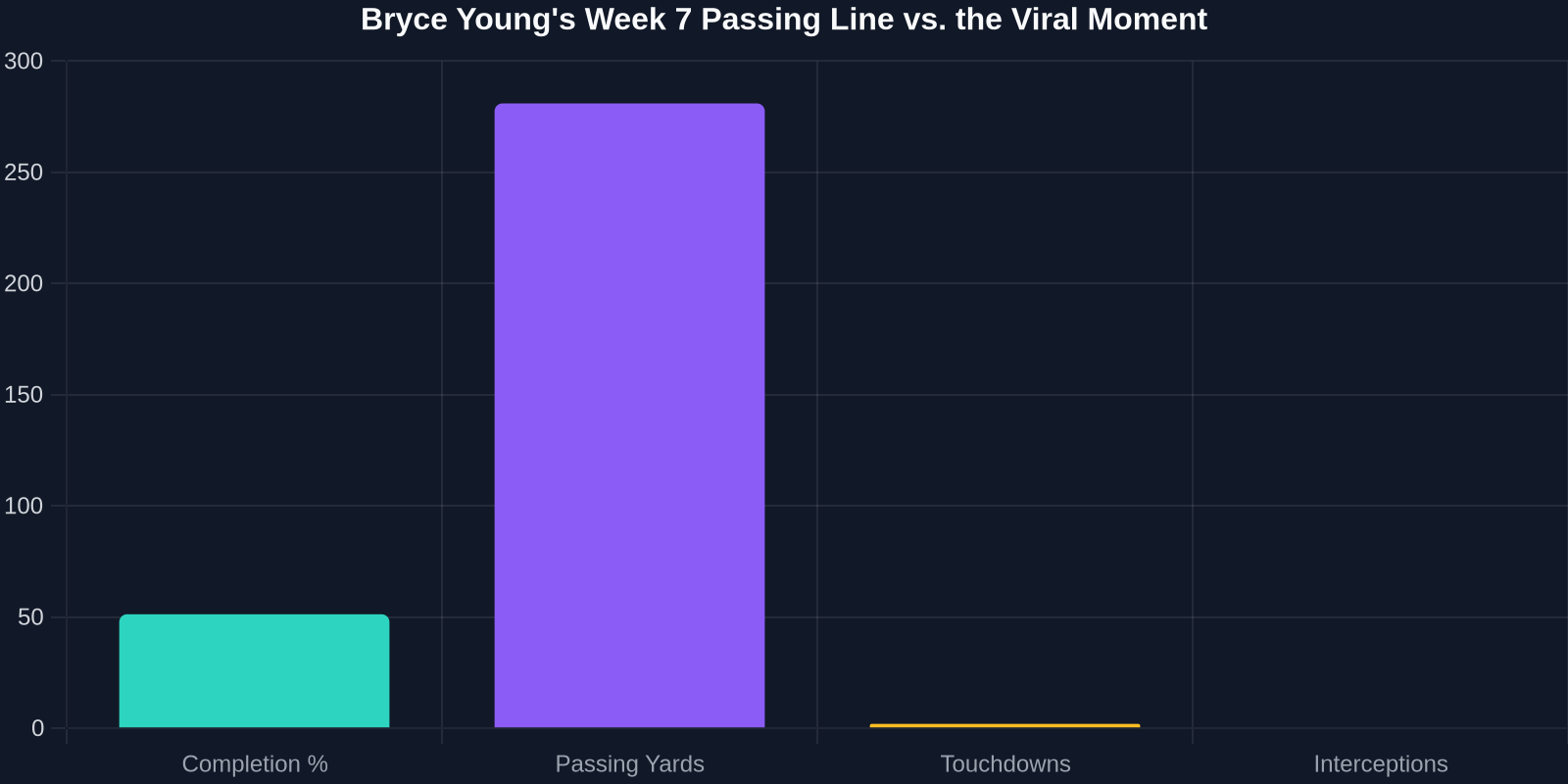
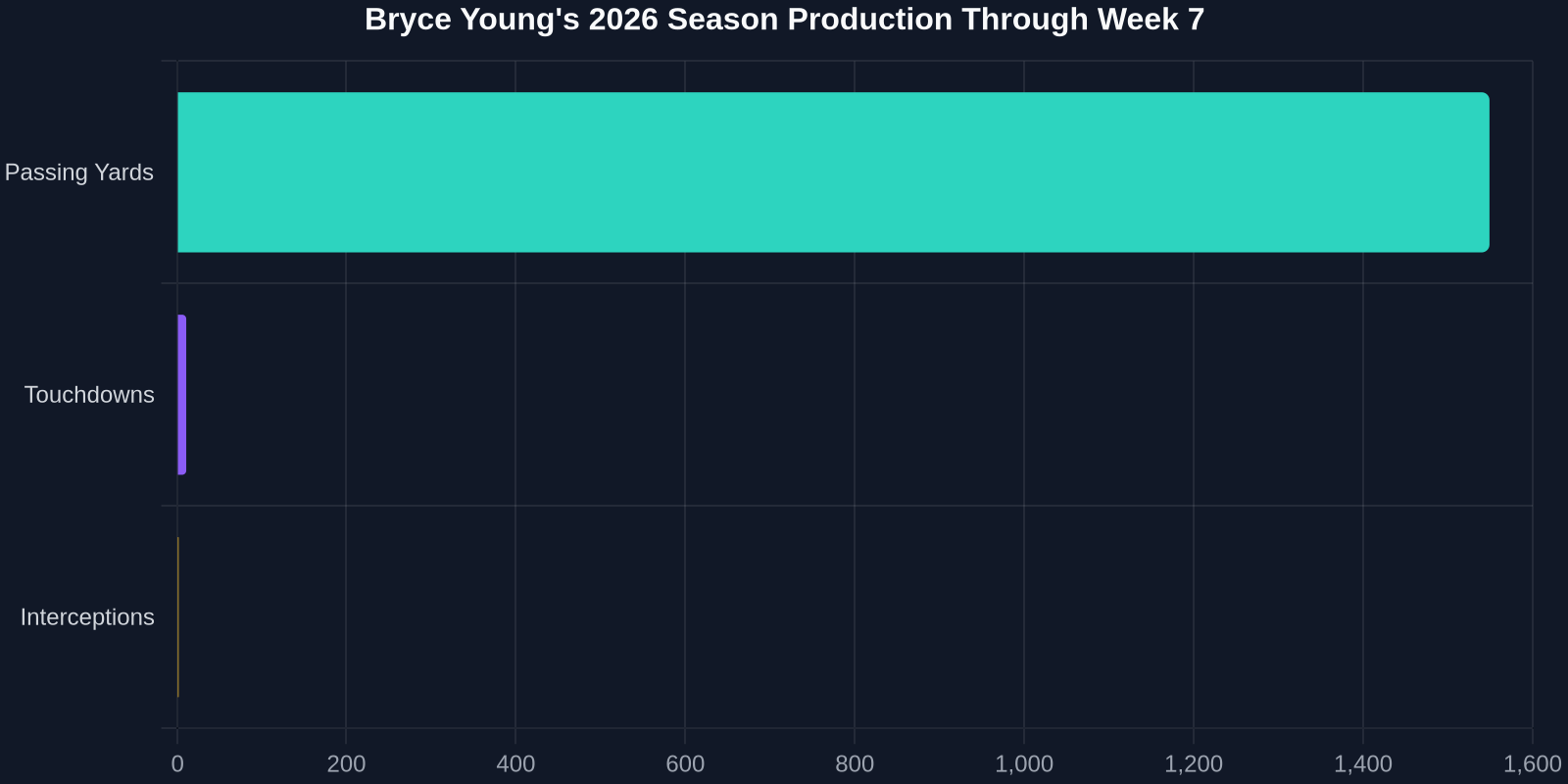
Context matters here. Through the first seven weeks of the 2026 season, Young has passed for 1,549 yards and 11 touchdowns with only two interceptions. Those numbers reflect a quarterback who is learning to balance risk and reward, and who is gaining the trust of his coaching staff. But the box score was not the story after Week 7. The story was the man behind the stats.
It is also worth noting that for the third time in six games, the Panthers defense entered a game without knowing exactly who they would face at quarterback on the other side. That kind of uncertainty can wear on a team, but Young's steady presence, both on and off the field, has become a stabilizing force in Charlotte.
A Pattern of Quiet Character, Not a One-Off
Anyone who has followed Bryce Young since his college days at Alabama knows that this moment did not come out of nowhere. Young has long been described by teammates and coaches as even-keeled, humble, and deeply respectful of opponents. The viral prayer was simply the first time a national audience saw that character on full display in an NFL jersey.
Earlier in the 2026 season, Young hosted the "Young 9 Sneaker Ball," a charity event centered around his love for sneakers. The fundraiser brought together fans, teammates, and community leaders to support youth initiatives in the Charlotte area. It was another example of Young using his platform for something other than self-promotion.
His consistency is precisely what makes the prayer meaningful. Anyone can stage a moment of compassion for the cameras. But when a player's daily life already reflects a quiet concern for others, a mid-game prayer feels less like an anomaly and more like an overflow of character.
What Scripture Says About Bearing One Another's Burdens
For Christians watching the clip, the connection to Galatians 6:2 was immediate. The King James Version puts it this way:

Bear ye one another's burdens, and so fulfil the law of Christ., Galatians 6:2 (KJV)
That verse does not say "bear the burdens only of those on your own team." It does not say "bear the burdens only of people who agree with you." It says one another, a sweeping call to carry the weight of any person God places in our path. In that moment on the football field, Bryce Young saw an opponent in pain and treated him as a neighbor, not as an enemy.
This is the heart of the gospel applied to everyday life. Jesus told the parable of the Good Samaritan to answer the question, "Who is my neighbor?" The answer was not a theological abstraction. It was a story about a man who stopped, crossed the road, and cared for someone who would have been considered an outsider. Young's prayer was a modern, three-second version of that same impulse: stop, notice, respond.
The Bible is filled with similar calls to compassion. Proverbs 17:17 (KJV) says, "A friend loveth at all times, and a brother is born for adversity." In the heat of competition, it's easy to forget that the person across the line of scrimmage is also someone's brother, someone's son, someone made in the image of God. Young's gesture was a quiet reminder that even in a violent, high-stakes game, our shared humanity matters more than the scoreboard.
Why This Matters for Everyday Believers
Most of us will never play in an NFL game. We will never have millions of people watching as we decide how to respond to someone else's pain. But the spiritual principle behind Young's viral moment is endlessly transferable to ordinary life.
Think about the last time you saw a coworker struggling with a deadline, a neighbor dealing with a sick child, or a friend navigating a quiet personal crisis. What did you do? Did you pause long enough to notice? Did you offer a word of encouragement, a helping hand, or a silent prayer? Or did you keep moving, too busy with your own responsibilities to stop?
The challenge of modern life is not that we lack opportunities to show compassion. The challenge is that we rarely slow down enough to see them. Our phones buzz. Our calendars fill. Our to-do lists grow. Meanwhile, hurting people stand right in front of us, waiting for someone to care.
The apostle Paul wrote in Philippians 2:4 (KJV), "Look not every man on his own things, but every man also on the things of others." That is a radical call in a self-focused culture. It asks us to shift our attention from our own performance, our own comfort, our own plans, and to deliberately consider what someone else is going through. Bryce Young modeled that shift on a football field. We can model it in our living rooms, our offices, and our church lobbies.
The Comparison: What Usually Goes Viral vs. What Did
To appreciate the significance of Young's prayer, it helps to compare it with the kinds of moments that typically dominate NFL highlight reels.

| Focus | Typical Viral NFL Moment | Bryce Young's Viral Moment |
|---|---|---|
| Primary emotion | Excitement or celebration | Compassion and concern |
| Main action | Touchdown dance or big hit | Bowing in prayer for an opponent |
| Fan response | Likes and highlight shares | Reflection on character and faith |
| Lasting impact | Fades by next Sunday | Sparks conversations about sportsmanship |
The difference is not that football highlights are bad. They are part of what makes the sport exciting. But when a moment of quiet compassion outpaces the latest touchdown celebration in cultural impact, it tells us something about what people are actually hungry for. We are tired of noise. We are drawn to sincerity.
How This Moment Challenges Us to Live Differently
The viral prayer is not a call to become more religious in public. It is a call to become more present in private. The most important part of Bryce Young's gesture was not that cameras captured it; it was that he actually stopped. He interrupted the flow of the game, set aside his own competitive focus, and acknowledged another person's suffering.
What would happen if we did the same? What if, the next time we saw someone struggling, we paused instead of scrolling? What if we sent a text instead of assuming someone else would reach out? What if we bowed our heads for a coworker who just received bad news, even if no one else saw it?
Jesus taught in Matthew 25:40 (KJV), "Verily I say unto you, Inasmuch as ye have done it unto one of the least of these my brethren, ye have done it unto me." According to Jesus, every act of compassion toward another person is, in some mysterious way, an act of service to God himself. That transforms the way we see ordinary moments. The person in front of us is not an interruption to our day; they are an opportunity to love Jesus.
A Small Habit to Try This Week
Here is a practical, low-pressure habit you can start this week, inspired by Bryce Young's viral moment. It takes less than sixty seconds a day.
Each morning, before you check your email or open social media, ask God to help you notice one person who needs encouragement. Then, as you go through your day, keep your eyes open for that person. It might be a cashier who looks tired, a coworker who is quieter than usual, or a family member who needs a listening ear. When you see them, offer a simple word of encouragement or a silent prayer.
That's it. No grand gestures. No public performances. Just a quiet commitment to notice, stop, and respond. Over time, this small habit can rewire the way you move through the world. You will begin to see people not as obstacles to your productivity, but as neighbors God has placed in your path.
For those who want a simple way to keep Scripture front and center throughout the day, Vesper places one King James Version verse on the Lock Screen and Home Screen each morning, a small reminder to keep your heart oriented toward compassion before the noise of the day begins.
Conclusion: The Power of a Quiet Moment
Bryce Young's prayer for an injured opponent will likely be remembered long after the final score of Week 7 fades from memory. Not because it was theologically profound or athletically impressive, but because it was authentically human. In a sport built on controlled violence and relentless competition, one young man chose tenderness. And in doing so, he reminded millions of us that compassion is not a weakness. It is, in fact, one of the clearest marks of strength.
So this week, keep your eyes open. Look not every man on his own things, but also on the things of others. You never know when a quiet, unnoticed prayer might become the most meaningful thing you do all day.