Religion Remains Stable in the U.S.: What Pew's New Findings Mean for Young Adults and Everyday Faith
Published on November 2, 2026 · 11 min read

Most American Christians have absorbed one gloomy story about faith in their country: it is shrinking, fast, and the next generation is walking away. So a headline announcing that religion remains stable in the United States lands oddly, like good news you are not sure you are allowed to trust.
That is roughly where the conversation stands after OSV News reported on Pew Research Center's latest reading of American religious life. The takeaway is not that everything is fine. It is something more textured, and honestly more useful: the long decline appears to have slowed, while young adults keep sending mixed signals about what they believe, how often they pray, and whether any of it belongs to a community.
For the everyday believer, the parent getting three kids out the door, the nurse finishing a twelve-hour shift, the retiree with a quiet house and a worn Bible, this is not an abstract data story. It is a map of the field we are actually standing in. And maps are meant to be read before you start walking.
What Pew's New Numbers Actually Say
Pew Research Center has been measuring American religion for nearly two decades through its Religious Landscape Study and its annual surveys. The broad arc is familiar to anyone who has sat in a pew lately: the share of Americans who identify as Christian has fallen, and the share who claim no religious affiliation at all has grown.
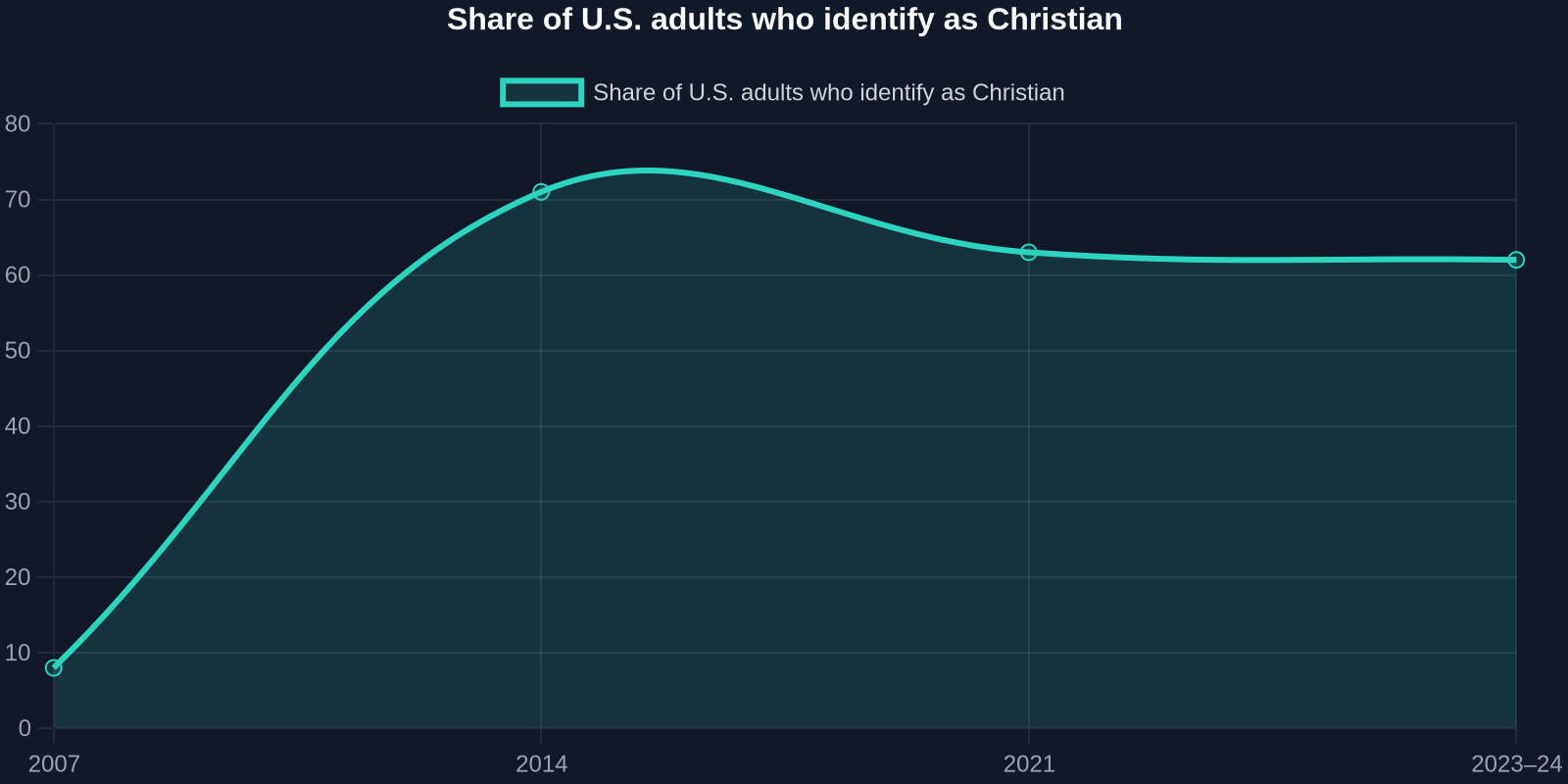
What the newest reporting emphasizes is the shape of that line rather than its direction. Recent surveys show the decline flattening, a plateau rather than a cliff. That is not a revival. It is a pause, and pauses are where ordinary faithfulness gets to do its work.
The clearest way to see the change is to look at the pace of it. Convert the headline numbers into average annual movement and the story sharpens considerably.
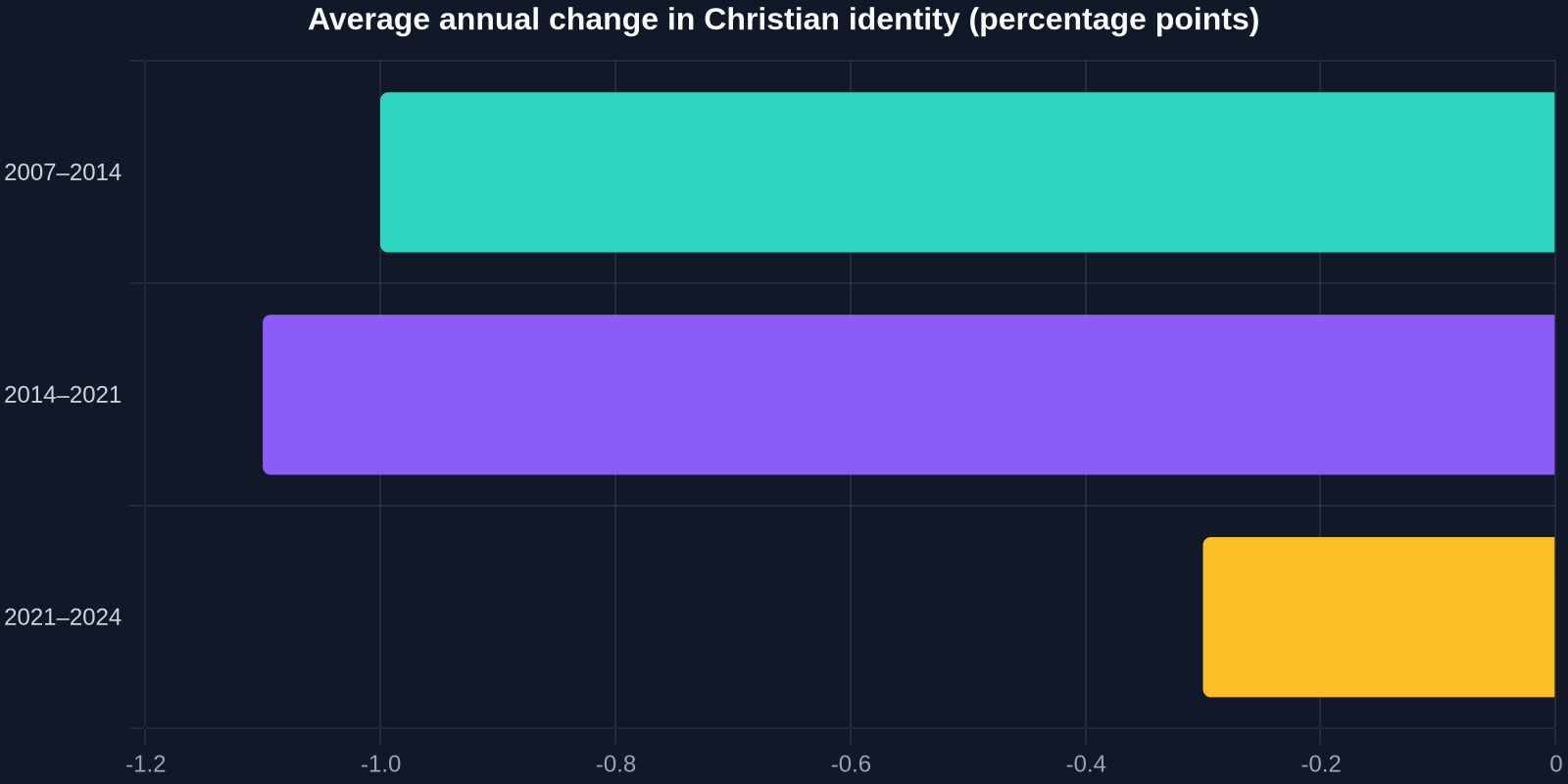
Between 2007 and 2014, Christian identity in the United States was falling by roughly a percentage point a year. From 2014 to 2021, that pace held or slightly accelerated. In the most recent surveys, the annual change has shrunk to a fraction of a point. Something has slowed down.
At the same time, the share of Americans with no religious affiliation, the group researchers often call the “nones”, has also stopped climbing as steeply.
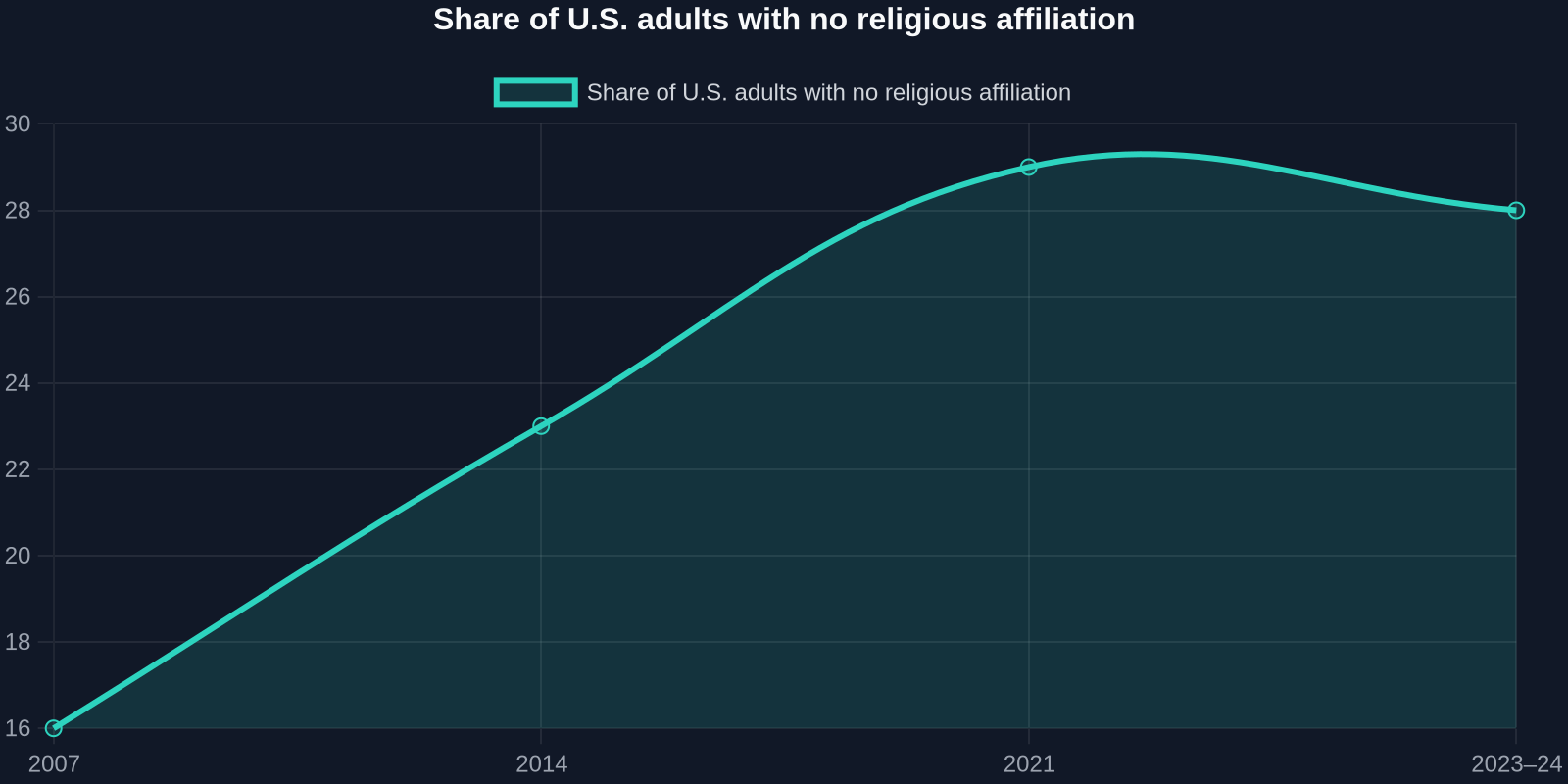
Read those charts side by side and you get a picture that is neither triumphant nor despairing. America is not becoming dramatically more religious. It is becoming more settled in whatever it is becoming. The sorting that began two decades ago may be closer to finished than we assumed.
The Mixed Signals From Young Adults
The subtitle of the Pew story matters as much as the headline. Young adults are the group everyone watches, and their answers resist a single verdict.

On one hand, that number is lower than the national figure and lower than what previous generations reported at the same age. On the other hand, a majority still claims a faith. The story is not a clean exodus. It is something closer to drift, pause, and ambivalence, people who have not decided, or who have decided partly, or who are quietly waiting to see whether anyone ever invites them in.
There is another nuance worth naming gently. Young adults today tend to be less interested in religious identity as a label and more interested in whether a practice actually does something. They are skeptical of inherited answers and suspicious of performance. But they are not, as a rule, hostile to the idea that God might be real.
That is a pastoral detail, not a statistical one. It means the first move is not to win an argument but to be findable, the neighbor who prays, the coworker who is honest, the family that keeps a Sunday rhythm without making a performance of it.
Why “Stable” Is a More Interesting Word Than It Sounds
Stability is easy to dismiss. It does not make a dramatic headline, and it does not flatter anyone's side. But stability is exactly the condition in which discipleship happens.
“One generation shall praise thy works to another, and shall declare thy mighty acts.”, Psalm 145:4 (KJV)
That verse assumes a kind of steadiness. It assumes there is a generation with something to say and a generation willing to listen, and that the passing happens through ordinary people rather than through cultural momentum. A plateau in the survey data is, in a small way, an opening for exactly that handoff.
Scripture is not surprised by any of this. It has always described faith as something carried in jars of clay by people who are tired, distracted, and sometimes unsure. “We will not hide them from their children, shewing to the generation to come the praises of the LORD, and his strength, and his wonderful works that he hath done” (Psalm 78:4, KJV). The Psalmist wrote that into a congregation that had already forgotten once and would forget again.
“The grass withereth, the flower fadeth: but the word of our God shall stand for ever” (Isaiah 40:8, KJV). Every survey is a snapshot of grass. The word underneath it is not measured by Pew, and it is not going anywhere.
What This Means for Ordinary Believers
So what does a stalled decline actually ask of the person who simply wants to follow Jesus this week?

Faith Is Becoming More Chosen Than Inherited
When a culture carries people to church by default, faith is largely inherited. When the defaults loosen, faith becomes more deliberately chosen, and chosen faith tends to be more examined, more articulate, and more durable.
That is a real cost and a real gift at the same time. Fewer people will show up out of habit. But those who do come may be there because they actually want to be, which is not nothing.
Young Adults Are Watching the Adults Around Them
“When I call to remembrance the unfeigned faith that is in thee, which dwelt first in thy grandmother Lois, and thy mother Eunice; and I am persuaded that in thee also” (2 Timothy 1:5, KJV).
Paul traces Timothy's faith through two generations of women. Not a program. Not a campaign. A household where faith was visible, unhypocritical, and simply present. That is still the most common mechanism by which faith travels.
If young adults are sending mixed signals, one reasonable response is not a better argument but a more visible life, a Bible open on the table, a prayer before the meal, a Sunday morning that does not get renegotiated every single week.
The Ordinary Means Still Work
There is a temptation to believe that this moment calls for something extraordinary: a new strategy, a bigger event, a cleverer message. But the means Scripture gives us are stubbornly ordinary, Scripture itself, prayer, worship, the gathered church, the shared meal, and the slow habit of telling the truth about God.
| Habit | Before | After |
|---|---|---|
| First thing in the morning | Phone and email | One verse, read slowly |
| Mealtime | Silent scrolling | A short prayer of thanks |
| Sunday morning | Negotiable | Non-negotiable |
| Talking about faith | Avoided as awkward | Occasional and matter-of-fact |
| Young adults in the room | An afterthought | Invited and trusted |
None of those changes is dramatic. All of them are repeatable. And repeatable is the whole point.
A Small Habit to Try This Week
Here is a practice that fits in the space between the survey data and your actual Tuesday: read one verse of Scripture before you look at anything else in the morning.
Choose the verse the night before. Write it on an index card. Leave your Bible open to it on the counter. Then, before coffee, before headlines, before the first message, read it once, out loud if you can manage it.
“And these words, which I command thee this day, shall be in thine heart: And thou shalt teach them diligently unto thy children, and shalt talk of them when thou sittest in thine house, and when thou walkest by the way, and when thou liest down, and when thou risest up” (Deuteronomy 6:6–7, KJV).
That passage ties together the two things this survey story is really about: what is in your heart, and how it gets into the next generation's heart. It happens when you rise up, and sit down, and walk along the way, not in a single breakthrough moment.
If you would like that verse in front of your eyes before the day starts, Vesper places one King James Version verse on your Lock Screen and Home Screen each morning.
Scripture to Carry With You
“It is of the LORD's mercies that we are not consumed, because his compassions fail not. They are new every morning: great is thy faithfulness.”, Lamentations 3:22–23 (KJV)
Lamentations is a book written after a catastrophe, by someone who had every reason to conclude that the story was over. He said instead that the mercies were new and the faithfulness was great. That is not denial. It is a theological judgment made in the middle of a discouraging situation, which is exactly where most of us read the news.
“Thy word is a lamp unto my feet, and a light unto my path” (Psalm 119:105, KJV). A lamp does not light the whole road. It lights the next step. That is enough for a Tuesday.
Frequently Asked Questions
Is religion actually declining in the United States?
Yes and no, and the nuance matters. The long-term trend since 2007 has been a declining share of Americans who identify as Christian and a rising share with no affiliation. Recent Pew Research Center surveys show that decline slowing significantly, which is why some outlets now describe religion as stable rather than shrinking. Stable is not the same as growing, but it is a meaningful change in trajectory.
Why do young adults give mixed signals about faith?
Part of the answer is that they are doing what young adults have always done, sorting out what they inherited from what they actually believe. Part of it is timing: the question of faith is often answered later than we expect. The surveys show a majority of young adults still claim a faith, even while institutional participation lags behind.
What can an ordinary Christian do about any of this?
More than the statistics suggest. Faith has always spread through households, friendships, and quiet consistency rather than through cultural momentum. That is genuinely good news for anyone who feels small in the face of a trend line.
How do I start reading the Bible daily?
Start smaller than feels impressive. One verse, at the same time, in the same place, with the same intention, to actually hear it. Consistency over volume is the whole principle. “Be ready always to give an answer to every man that asketh you a reason of the hope that is in you with meekness and fear” (1 Peter 3:15, KJV) is built on years of small mornings, not one large resolution.
The Long Obedience in the Same Direction
Two things are true at once, and holding them together is the work of a mature faith. American religion is not collapsing as quickly as the gloomiest readings suggest, and it is not flourishing as the most optimistic ones might. It is steadying, into a shape that asks more of ordinary believers, not less.
“Jesus Christ the same yesterday, and to day, and for ever” (Hebrews 13:8, KJV). That is the line that does not plateau, and it is the line a single verse can put in front of your eyes before the day begins.
The data will be revised. The trends will bend. Read one verse tomorrow morning, and let the Lord of the data be the Lord of your day.