The Quiet Crisis in the Pews: Why Biblical Literacy Matters More Than Ever
Published on November 7, 2026 · 10 min read
If you sat down with a friend from church and asked them to name the Ten Commandments in order, could they do it? What about explaining what Paul means by "justification by faith"? For many of us, that question creates a knot in our stomach. We believe in the Bible. We treasure it. But if we are honest, the deep, working knowledge of Scripture that marked generations past feels elusive today. A recent Lifeway Research survey put numbers to that sinking feeling, revealing a startling deficit in biblical understanding among regular churchgoers. This is not a report meant to shame anyone. Instead, it is an invitation, a gentle, pastoral call to rediscover the living Word of God not as a textbook for a test, but as daily bread for a hungry soul.
The findings stop you in your tracks. When nearly two-thirds of the people in the pews struggle to place Solomon in the correct testament or identify the core themes of the Gospels, we aren't just looking at a gap in trivia knowledge. We are looking at a spiritual vulnerability. The prophet Hosea lamented, "My people are destroyed for lack of knowledge" (Hosea 4:6). In a world overflowing with competing voices, self-help gurus, algorithmic feeds, and 24-hour news cycles, a shaky grasp of Scripture leaves us "tossed to and fro, and carried about with every wind of doctrine" (Ephesians 4:14). Yet, this is actually a moment of immense hope. Recognizing the deficit is the first step toward a deeper, more resilient faith.
Moving Beyond Guilt to Genuine Engagement
Often, when we hear about falling biblical literacy, the first reaction is guilt. We picture a rigorous reading plan that we failed in February or a highlighter that dried out back in Leviticus. But the goal is not to cram for a spiritual exam. The Pharisees of Jesus' day had memorized vast swaths of text, yet He told them, "Ye do err, not knowing the scriptures, nor the power of God" (Matthew 22:29). Biblical literacy is not merely data retention; it is a relational knowing. It is learning the voice of the Good Shepherd so clearly that we can distinguish it from the static of the world.
Why the Historical Context of Our Bible Matters
We live in a unique moment of history. The King James Version, published in 1611, democratized the Scripture for the English-speaking world in a way unseen before. This translation, with its majestic cadence, was not just a book on a shelf but a cultural and spiritual foundation. Families centered their days around its rhythms. Children learned to read by tracing its letters. Public discourse was saturated with its phrases. Today, we have more access to Bibles than at any point in history, on our phones, in our apps, on our nightstands, yet the Bible is often a closed book. We don't suffer from lack of access; we suffer from a surplus of distraction.
The shift from a print-centric culture to a screen-centric one has changed our reading patterns. We skim. We scroll. We pause for headlines, not the psalms. God's Word invites a different pace. "But his delight is in the law of the Lord; and in his law doth he meditate day and night" (Psalm 1:2). The Hebrew word for meditate, hagah, implies a low murmuring, a chewing on the words. You cannot chew what you only sample. This lack of deep reading contributes directly to the literacy gap. We know the verses out of context but miss the great narrative arc from the garden of Eden to the garden tomb.
Weaving Scripture into the Grain of a Busy Day
For the everyday Christian, the parent packing lunches, the commuter stuck in traffic, the shift worker collapsing into bed, a long, uninterrupted hour of quiet study often sounds like a luxury reserved for a different season of life. The answer is not to feel defeated but to integrate. In the Old Testament, God commanded His people to bind His words as a sign on their hands and as frontlets between their eyes (Deuteronomy 6:8). This imagery isn't about literal phylacteries alone; it's about placing the Word at the intersection of our actions (the hand) and our thoughts (the forehead).
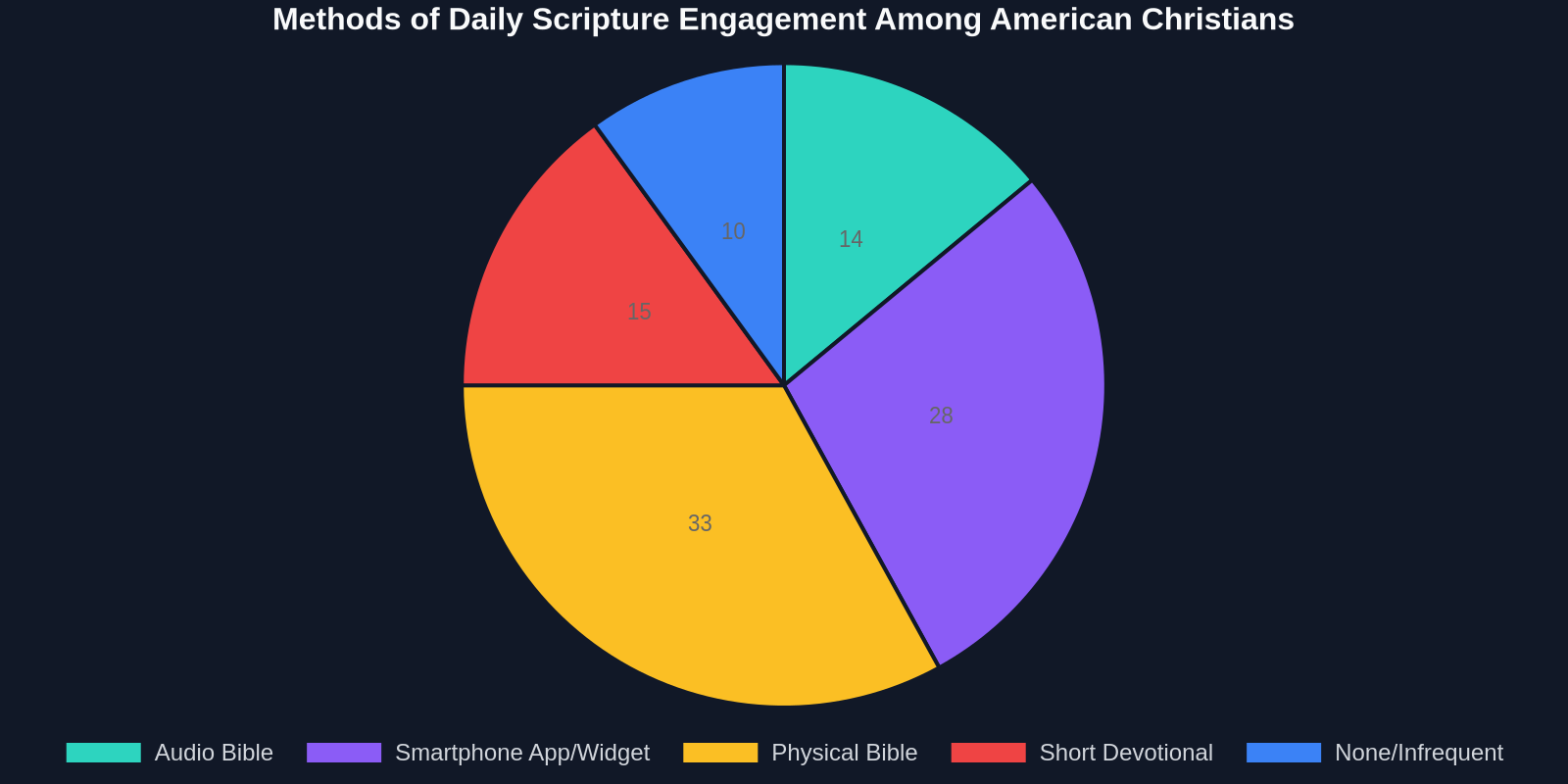
This is where the wisdom of small, consistent habits shines. It's the single verse read with your coffee. It’s the audio chapter played in the school pick-up line. It’s the Psalm prayed aloud before you check your email. These moments act like trellises for a vine, giving fragile intentions a structure to grow on. When Jesus taught us to pray for our "daily bread," He specified just enough for today. We similarly need a daily word.
The Lock Screen as a Frontlet: A New Habit
We check our phones hundreds of times a day. Every glance at the screen is an opportunity. Instead of being greeted by a notification that triggers anxiety, that space can become a holy frontlet. When David wrote, "Thy word have I hid in mine heart, that I might not sin against thee" (Psalm 119:11), he didn't have a smartphone, but the principle is the same. Hiding the Word in our hearts starts with planting it before our eyes. A single verse on a lock screen, like Behold, God is my salvation; I will trust, and not be afraid (Isaiah 12:2), shifts our center of gravity back to Christ seventeen seconds at a time. Vesper offers a quiet, simple way to see a daily KJV verse on your Lock Screen, making this ancient practice effortless in a modern age.
The Community Connection: Guarding Against Lone-Wolf Faith
Biblical literacy was never intended to be a private achievement. Until the modern era, most Christians heard the Word read aloud in a community gathering. They experienced it together, complete with the gasps, the tears, and the murmured amens of their neighbors. This collective hearing provided a guardrail against wild misinterpretation. Today, many of us are engaging with Bible content in isolation, often through online platforms where eccentric interpretations can thrive without the accountability of a local church body.

The local church, the small group, and the family dinner table are irreplaceable contexts for literacy. When we hear how the Word is hitting the life of the single mom across the table or the retiree who has walked with Jesus for fifty years, the text becomes three-dimensional. "Iron sharpeneth iron; so a man sharpeneth the countenance of his friend" (Proverbs 27:17). This sharpening process is where we learn to rightly divide the word of truth.
News That Connects to the Word
Being biblically literate fundamentally changes how we process the news. When we hear of natural disasters, the literate heart remembers that "the whole creation groaneth and travaileth in pain together until now" (Romans 8:22), pointing us toward redemption rather than despair. When we read of a neighbor's kindness, we see a reflection of the Samaritan who "had compassion on him" (Luke 10:33).
Even the gathering of believers for events, from a small-town prayer breakfast to a regional worship night, is part of this counter-formation. When a community calendar fills up with opportunities to hear preaching, engage in service, and sing the Psalms, it’s a public declaration that we live by "every word that proceedeth out of the mouth of God" (Matthew 4:4). These local gatherings are the training grounds where theory meets practice.
Rebuilding a Culture of Scripture, One Day at a Time
The rebuilding of biblical literacy won't be spearheaded by a giant campaign or a single viral moment online. It will happen in the quiet determinism of thousands of ordinary believers deciding to stop waiting for a perfect season. It's choosing the miracle of the loaves and fishes approach, bringing the little you have (five minutes, a distracted mind, a tired body) to Jesus and watching Him multiply it.

| Habit | Distracted Approach | Literacy-Building Approach |
|---|---|---|
| First thing in the morning | Checking social media or email immediately | Reciting a verse from yesterday's lock screen before rising |
| During a stressful moment | Grasping for a self-help mantra | Breathing in a specific promise like Philippians 4:6-7 |
| Before a meal | Rushing to eat in front of a screen | Pausing for a genuine reading of a verse of thanksgiving |
| Winding down at night | Scrolling news aggregators | Reading one Psalm aloud with family or a roommate |
Take confidence in the map of Scripture itself. It’s a story where God continually provides the way. The literacy gap isn't a canyon too wide to cross; it's a threshold. The first step is desire, and that desire is a gift already stirring in you if you've read this far. The Holy Spirit, the great teacher, promised to "guide you into all truth" (John 16:13). He is more eager to illuminate the Word than you are to understand it.
The Scripture is a "lamp unto my feet, and a light unto my path" (Psalm 119:105). It doesn’t light up the whole ten-mile stretch of road ahead; it lights up the step right in front of you. The Lifeway survey isn't a condemnation, it's a spotlight, showing us where the path has eroded so we can walk more carefully.
“Be ye doers of the word, and not hearers only, deceiving your own selves.”, James 1:22
This journey back to literacy is really a journey into stability. A man who prays the Psalms daily instinctively reaches for "The Lord is my shepherd; I shall not want" (Psalm 23:1) when the bank account dwindles because the script is already written on his heart. A woman who has marinated in Ephesians can walk into a tense boardroom knowing the real fight is not against "flesh and blood, but against principalities, against powers" (Ephesians 6:12). This is the peace that passes understanding, not an escape from reality, but a fortified mind held steady by the anchor of a truthful reality.
A Reflection for the Coming Week
This week, try a very small habit: an electronic fast for the first and last sixty seconds of your day. Let the very first light your waking eyes see be not a blue screen of alerts, but a line of Scripture illuminating the morning grogginess. And let the last whisper before sleep be an ancient promise, a doxology of praise, or a simple acknowledgment: "I will both lay me down in peace, and sleep: for thou, Lord, only makest me dwell in safety" (Psalm 4:8).
Rebuilding biblical literacy is not about winning a quiz night. It’s about looking into the perfect law of liberty and letting it reshape our loves, our reflexes, and our minds. Start there. One day. One line. One Word.