What the World Values Survey Reveals About Global Belief in God
Published on October 19, 2026 · 10 min read

A vast new global study has pulled back the curtain on humanity’s deepest longings. The World Values Survey, a decades‑long research project spanning nearly 80 countries, is once again asking the ancient question: Do you believe in God? The answers reveal a world where faith endures, adapts, and often defies the expectations of a secular age.
For the everyday Christian, juggling work, family, and a relentless news cycle, these findings are more than academic. They are a quiet reminder that the longing for the Creator is woven into the fabric of nations. From Jerusalem to Jakarta, millions still look upward. And that shared hope can shape the way we pray, work, and start each new morning.
A Snapshot from Israel: Faith That Persists
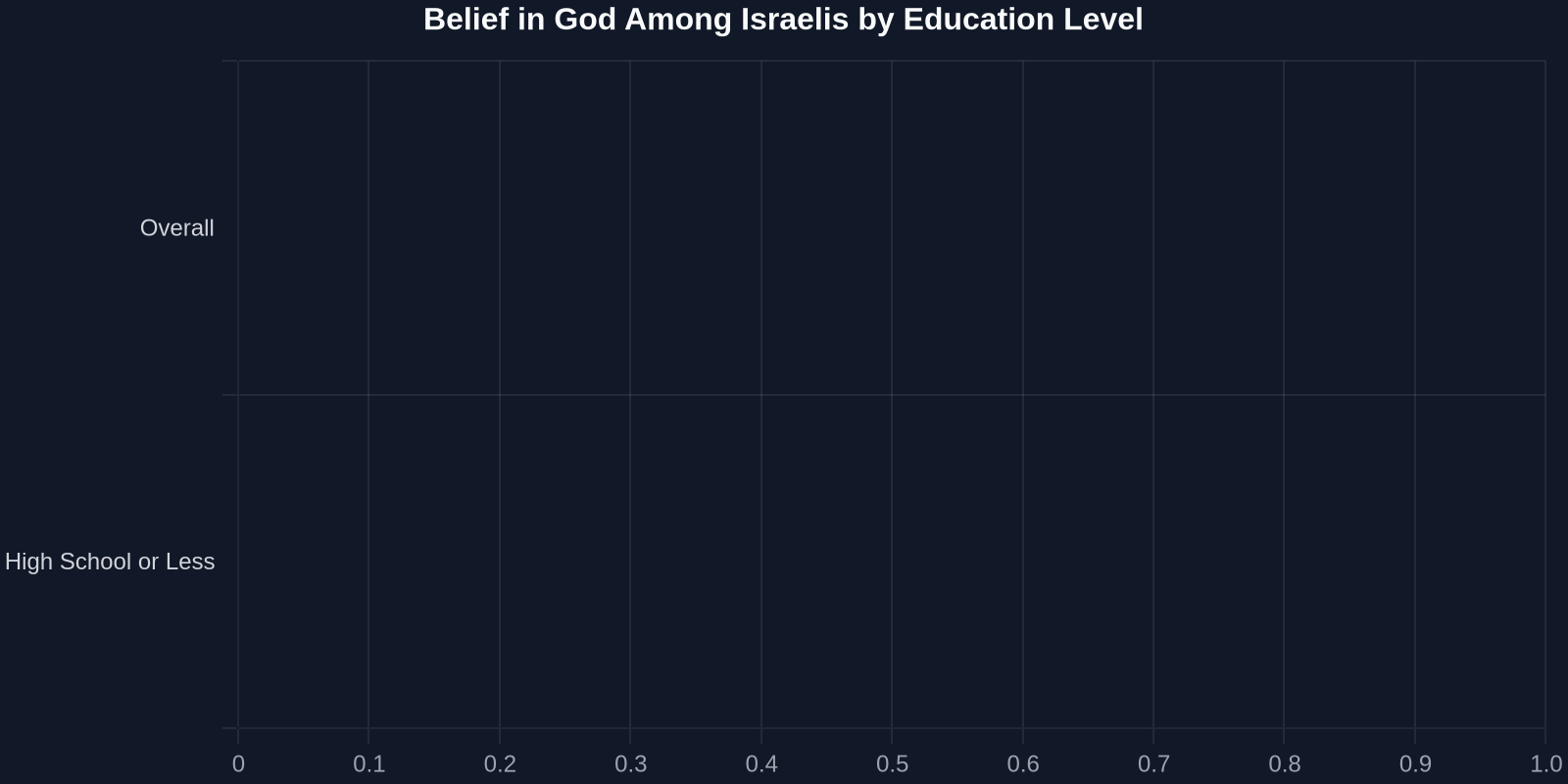
The survey’s data from Israel offers a striking portrait. In a nation often viewed through a political lens, spiritual belief remains remarkably robust. The numbers tell a simple story:
That figure alone stops the hurried reader. Three out of every four people, across a society known for its high-tech innovation and secular Tel Aviv, affirm a personal God. It’s a testament that faith is not merely a relic of the past.
But the data get even more interesting when we look at education. Among Israelis with a high school education or less, the percentage of believers climbs sharply:
Here we see a major theme of the World Values Survey: education levels and belief are closely linked, but not always in the way popular culture suggests. As we’ll explore, the story is more grace than gloom.
What Lies Behind the Numbers?
Some pundits are quick to interpret such data as a victory for faith among the “simple.” That would be a mistake. The survey isn’t measuring intelligence; it’s measuring how different life experiences shape the questions people ask. A person with less formal education may spend more hours in community, in family, or in direct reliance on God for daily bread, all soil where belief in a personal God grows naturally.
Equally important is the strong majority of believers among the university‑educated. Even in that demographic, a significant segment holds fast to God. The takeaway for the ordinary Christian is liberating: your faith doesn’t have to be on a collision course with learning. Throughout Scripture, wisdom and knowledge are celebrated as gifts from God. Proverbs 1:7 reminds us, “The fear of the Lord is the beginning of knowledge: but fools despise wisdom and instruction.” The World Values Survey suggests many educated people haven’t abandoned that fear; they’ve simply learned to hold science and the sacred in a quiet, personal tension.
A Global Perspective: Where the World Stands
Zooming out from Israel, the World Values Survey paints a picture of a planet that is far more religious than some Western headlines would have us believe. While Europe may see declining church attendance, the global average of belief in God remains strikingly high. Drawing on recent waves of the survey, over 70% of respondents worldwide answer “yes” when asked if they believe in God.

That’s not a misprint. In an era of smartphones and space telescopes, nearly three‑quarters of humanity profess faith in a divine being. For the Christian reader, this statistic is a quiet anchor. When the daily news sows doubt, it’s good to remember that millions of neighbours across the globe are waking up with the same foundational conviction: God is.
Another large‑scale study, the 2015 Pew Research Center report, found that 89% of the world’s population identified with a religious group or expressed belief in God or a universal spirit. While the World Values Survey’s current wave registers a slightly lower 72% (due to different question phrasing and a larger pool of non‑religious respondents in some countries), the overall pattern is the same: unbelief remains a minority view.
The Decline That Isn’t a Collapse
To be candid, the global trend line has dipped very gently over the last two decades. The World Values Survey reveals a slow move: roughly 82% belief in 2000, about 78% in 2010, and now 72% in 2020. That’s a ten‑point shift over twenty years, significant, but hardly an avalanche.
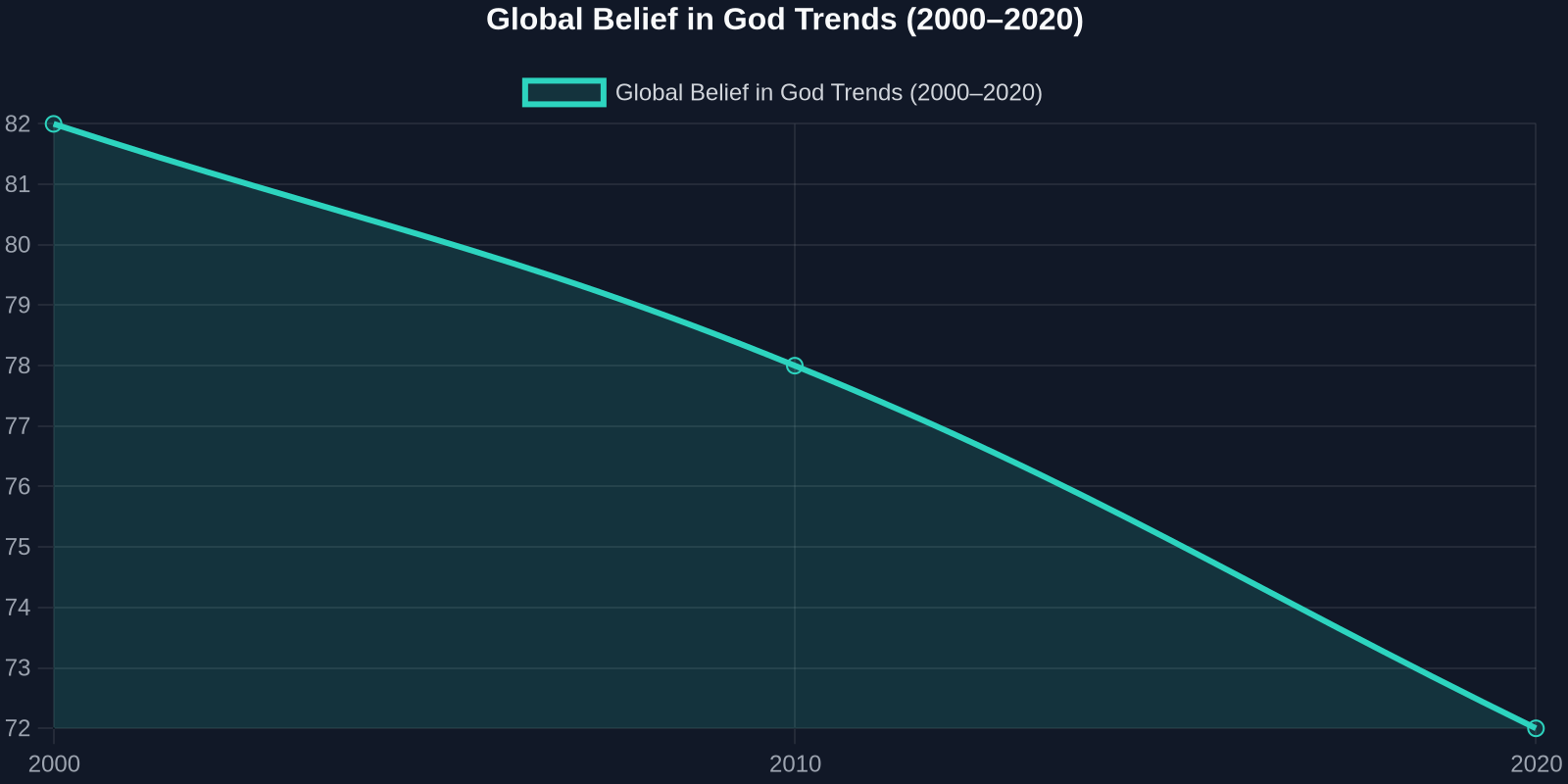
Why the mild decline? Demographers point to several factors: ageing populations in highly secular Europe, the rise of the “nones” (people who claim no religious affiliation) in the West, and a growing number of young people who were raised without any faith practice. Yet even as these trends unfold, the absolute number of believers worldwide continues to rise because the global population is growing fastest in deeply religious regions.
The Christian looking at these numbers can take a balanced view. There is no need to panic, and no room for complacency. Jesus told His disciples that the harvest is plentiful, but the labourers are few (Matthew 9:37). The harvest is still plentiful. The data confirm it. The question is how we live as labourers in a field that is still white for harvest.
What Does This Mean for the Modern Believer?
Numbers on a page can feel distant. Your daily life is not a global survey, it’s a series of small choices made between the alarm clock and the bedside lamp. So how does the knowledge that most people still believe in God change your Tuesday?
1. You Are Not Alone
When you scroll past a mocking post about faith or sit through a meeting where God is politely ignored, it’s easy to feel like a relic. The World Values Survey is a gentle nudge: you are standing with the vast majority of the human race. Across continents and cultures, normal people, busy parents, shopkeepers, students, still pray, still look to heaven, still whisper “Thank you, God” when a worry lifts.
2. Faith and Education Can Coexist
The Israeli data’s 74% overall figure, including many with advanced degrees, shows that believing in God does not require checking your brain at the door. As a Christian, you can pursue truth in the laboratory, the library, or the boardroom, confident that all truth is God’s truth. The apostle Paul, a man of towering intellect, wrote that God’s invisible attributes are “clearly seen, being understood by the things that are made” (Romans 1:20). The World Values Survey indicates that millions of educated people still see.
3. The Mission Field Is Near and Far
Because belief remains widespread, the task of the Christian is not merely to convince atheists. It is to help nominal believers encounter the living Christ. Many people around the world believe in a vague “God” but have never tasted the grace of Jesus. The Great Commission is not obsolete; it is urgent. And it often begins with a simple, daily witness, a patient love, a scripture shared at the right moment.
The Practical Difference: Weaving Faith into Everyday Life
Information without application fades. The survey’s real value for a believer in Christ is in how it reshapes our daily habits. Below is a gentle comparison of how a typical day might look when faith moves from the margins to the centre.

| Habit | Before | After |
|---|---|---|
| First Thing in the Morning | Grabbing the phone to check emails and news | Reading one verse of Scripture before any screen |
| Midday Reset | Scrolling social media during lunch | Pausing to recall the morning verse and pray |
| Evening Wind‑Down | Binge‑watching shows until sleep | Ending the day with a Psalm and a written reflection |
These tiny shifts are not about perfection; they’re about presence. When the World Values Survey shows that most of humanity still believes in God, it invites us to live as though that belief matters every hour, not just on Sunday.
One simple way to make the first shift stick is to place Scripture where your eyes land first. A tool like Vesper, an iOS widget that puts a daily King James Version verse right on your Lock Screen, helps you meet God before you ever meet a notification.
Five Small Habits to Start the Day with God
Drawing from the survey’s reminder that belief thrives when it’s practiced, here are five gentle habits any Christian can adopt this week.
-
Anchor the Morning with One Verse
Before your feet hit the floor, speak a short KJV verse aloud. 2 Timothy 3:16 says, “All scripture is given by inspiration of God, and is profitable for doctrine, for reproof, for correction, for instruction in righteousness.” Let one inspired sentence set the compass for the day. -
Pause at 10:00 AM and 3:00 PM
Set a quick reminder on your phone. When it buzzes, take sixty seconds to turn the morning verse over in your mind. Ask God what He wants you to see in it. -
Link a Prayer to a Physical Object
Every time you wash your hands, breathe a sentence of gratitude. This tiny ritual tethers the abstract fact that “God exists” to the concrete reality of water and skin. -
Share a Verse at the Dinner Table
Even if your household includes non‑believers, mentioning what you’re reading in the Bible can be a gentle, non‑confrontational witness. The survey’s high global belief numbers remind us that many hearts are already half‑open. -
End with a Question, Not a Screen
At night, ask yourself: Where did I notice God today? Write down one sentence. This practice turns God from a survey statistic into a living Person who showed up in your actual life.
The Quiet Pulse That Unites Us
In every century, believers have feared that faith is dying. The prophets of Israel felt alone. Elijah cried, “I, even I only, am left” (1 Kings 19:10). Yet God answered him with the reassurance that seven thousand others had not bowed the knee to Baal.

The World Values Survey is a modern echo of that reassurance. Yes, some corners of the world have grown cold. But the heart of humanity still beats with the question, Is there a God who knows my name?
“The fool hath said in his heart, There is no God.”, Psalm 14:1 (KJV)
For the Christian who sometimes feels like a fool for believing, that verse is a paradox of comfort. It reminds us that denial of God is the minority report in human history. The world, for all its noise, is still a cathedral.
What This Means for Your Week Ahead
As you step into the next few days, carry this thought: the faith you hold is not a private eccentricity. It is the shared anthem of billions. That doesn’t make it true, truth rests on the risen Christ and the Word of God, but it does make it profoundly human and deeply connected.
Let the knowledge that most people across the globe still look toward heaven encourage you to look a little more intentionally. Let it soften your heart toward the sceptic at work. Let it stir a quiet confidence that the gospel is still good news for a world that already suspects there is a God.
And if you need a simple reminder, let the next sunrise find you reading, just for a moment, a verse that has outlived empires. The same God who inspired those words is still seeking worshippers among every kindred, tongue, and people. The survey confirms it. Your own quiet morning can begin to prove it.