Why Gen Z Is Turning to the King James Bible for Daily Rhythms
Published on October 20, 2026 · 11 min read

For years, the story of faith among younger generations has been told as one of decline, empty pews, fading traditions, and a quiet drift toward secularism. But a new conversation is emerging, and it turns on a surprising pivot: a growing number of Gen Z believers are reaching not for the latest devotional app or modern paraphrase, but for the stately, 400-year-old cadences of the King James Version.
A recent opinion piece in The New York Times explores this quiet movement, noting how the King James Bible, often shortened to KJV, has found fresh resonance among young adults seeking depth, beauty, and a sense of rootedness in a fast-moving digital age. The article suggests that for many in Gen Z, the KJV is not a relic but a refuge: a text whose formal, poetic language slows the mind and invites a kind of attention that modern life rarely permits.
This is not a story about politics or denominational strife. It is a story about hunger, a hunger for words that carry weight, for rhythms older than the news cycle, for a daily encounter with Scripture that feels less like a task and more like a gift.
The Allure of Ancient Words
Why would a generation raised on short-form video and instant messaging gravitate toward a translation known for its thees and thous, its archaic verbs, and its stately punctuation? The answer lies in the very friction the KJV creates.
Modern Bible translations aim for clarity and accessibility, and they serve an important purpose. But the King James Version does something different: it arrests the reader. The language is not breezy. It does not skim. It asks to be spoken aloud, savored, and pondered. In an era of infinite scrolling, the KJV offers the opposite, a deliberate pace.
Consider the opening of Psalm 23 in the KJV: “The Lord is my shepherd; I shall not want.” The semicolon does work. It pauses the breath. It creates a hinge between the shepherd's identity and the believer's trust. Modern translations often smooth this into “The Lord is my shepherd, I lack nothing,” which is accurate but flatter. The KJV preserves a kind of liturgical heft that many Gen Z readers describe as “sacred” rather than simply “old.”
The New York Times piece highlights several young people who describe reading the KJV as a form of resistance to the attention economy. One college student quoted in the article says the archaic phrasing forces her to slow down and “chew on the words” instead of skimming for a quick takeaway. That chewing, she says, is precisely what her soul needed.
From Scroll to Screen: A New Daily Habit
For all its ancient language, the KJV's resurgence among Gen Z is deeply tied to modern technology. The same phones that deliver endless distractions can also deliver a single verse at just the right moment. And that is where a small shift in habit can change an entire day.

| Habit | Before | After |
|---|---|---|
| First thing in the morning | Checking email or social media | Reading one KJV verse from the Lock Screen |
| During a coffee break | Scrolling news headlines | Reciting a Psalm from memory |
| Before bed | Watching short videos | Meditating on a verse and praying |
This table may feel like an oversimplification, but habit researchers agree: replacing a low-value cue with a high-value one is more effective than trying to eliminate the cue altogether. If the first thing a person does is pick up their phone, the question becomes: what should the phone show? A verse from the King James Version, rendered in beautiful type on the Lock Screen, can turn a moment of mindless unlocking into a moment of worship.
The discipline of a daily verse may seem small, but it compounds. A single verse each morning becomes roughly 365 encounters with Scripture in a year. That is 365 moments where the ancient text meets a modern life. For many Gen Z believers, that rhythm is enough to anchor the rest of the day.
Why the King James Version Specifically?
It would be easy to assume that any Bible translation would do. But the KJV holds a unique place in English-speaking Christianity. Commissioned in 1604 and completed in 1611, it was the work of more than fifty scholars who aimed for both accuracy and literary excellence. The result was not merely a translation but a cornerstone of the English language itself, phrases like “a fly in the ointment,” “the powers that be,” and “by the skin of my teeth” all come directly from the KJV.
For Gen Z, many of whom encounter the KJV first through literature, music, or film, the translation carries a cultural familiarity that feels both nostalgic and new. It is the language of Shakespeare and of countless hymns. It is quoted by everyone from Martin Luther King Jr. to Cormac McCarthy. To read the KJV is to tap into a deep stream of English expression.
“Thy word is a lamp unto my feet, and a light unto my path.” , Psalm 119:105 (KJV)
The KJV also carries what one young reader in the Times piece calls “a seriousness of tone.” In a culture that often treats spirituality as a casual self-improvement tool, the KJV's formal address, its reverent “thou” and “thee” directed toward God, restores a sense of awe. It reminds the reader that they are not browsing options but standing before the Almighty.
That sense of reverence does not require theological precision; it is a felt quality of the language. The same verse in a modern translation may inform the mind, but the KJV often moves the heart. And for a generation hungry for transcendence, that difference matters.
A Quiet Counterculture of Depth
It is tempting to frame the KJV's resurgence as a rebellion against modernity, a kind of retro-liturgical protest. But the young people quoted in the New York Times article resist that framing. They are not trying to escape the present; they are trying to inhabit it more fully.

One interviewee, a 24-year-old graphic designer from Austin, describes reading the KJV each morning as “putting on armor.” She does not mean armor against other people, but against the fragmentation of her own attention. The verses, she says, “gather me back together before the day starts pulling me apart.”
This is not about legalism or performance. It is about creating a small sacred space in the day. The KJV, with its slow cadence and weighty diction, is particularly suited to that purpose. You cannot rush through “The Lord is my light and my salvation; whom shall I fear?” (Psalm 27:1). The words themselves set the pace.
This shift from information to formation is significant. Modern life treats reading as an act of extraction: get the point, move on. But the KJV resists extraction. Its poetry and parallelism invite the reader to linger, to repeat, to memorize. And memorization, once a common spiritual practice, is making a quiet comeback among Gen Z. A verse committed to memory becomes a portable sanctuary, available at any moment.
Practical Steps to Begin a KJV Rhythm
If you are curious about the King James Version but unsure where to start, the first step is smaller than you think. You do not need a new Bible, a study guide, or a long reading plan. You need one verse, once a day, in a place you cannot miss.
1. Choose a consistent moment
Anchor your KJV verse to an existing habit. Morning is often best because it sets the tone for the day, but lunchtime or just before bed works as well. The key is consistency, not duration. Thirty seconds with one verse is enough to begin.
2. Let the phone serve you
The same device that fragments your attention can also deliver a daily verse. A simple Lock Screen widget that shows one King James verse each day removes all friction. You unlock your phone and the verse is already there, before email, before news, before social media.
Vesper is one such tool, offering a single KJV verse on the Lock Screen and Home Screen each day, woven quietly into the rhythm of your phone.
3. Read the verse aloud
Even if you are alone, reading aloud engages a different part of the brain and slows you down. The KJV's rhythms are made for the voice. Let the sounds of “he restoreth my soul” linger in the room.
4. Carry one phrase with you
Do not try to memorize the whole verse at first. Pick one phrase, perhaps “peace, be still” or “my cup runneth over”, and repeat it through the day. That phrase becomes a thread connecting your morning moment to your afternoon responsibilities.
5. Journal a single sentence
After reading, write one sentence in a notebook or notes app: what this verse says about God, or what it says about you. The goal is not commentary but connection, a brief record of your encounter with the text.
These steps are not a program to master; they are an invitation to begin. The King James Version has waited four centuries for you. It will wait a little longer if you miss a day. But once the rhythm takes hold, you may find that the ancient words become a kind of heartbeat, steady, unforced, and always there.
The Bigger Picture: What This Means for the Church
The New York Times article is careful not to overstate the trend. Gen Z is not flooding back to pews in record numbers, and the KJV is not replacing modern translations in every context. But the piece does suggest something meaningful: when young people are given a text that treats them as whole persons, mind, heart, and ear, they respond.

The church has often worried about how to make Scripture relevant to younger generations. The answer, it seems, may not be to make it easier or trendier. The answer may be to offer the richest, most demanding, most beautiful version available, and trust that the hunger for depth is real.
For the everyday believer, this trend is not an abstraction. It is an invitation to reconsider your own daily routine. Do you encounter Scripture as a task to complete or as a gift to receive? Are you reading for information or for formation? And what might change if you traded ten minutes of morning scrolling for thirty seconds of the King James Version?
The answer, like the KJV itself, is not loud. It is quiet, steady, and patient. But it has the power to reorder a life, one verse at a time.
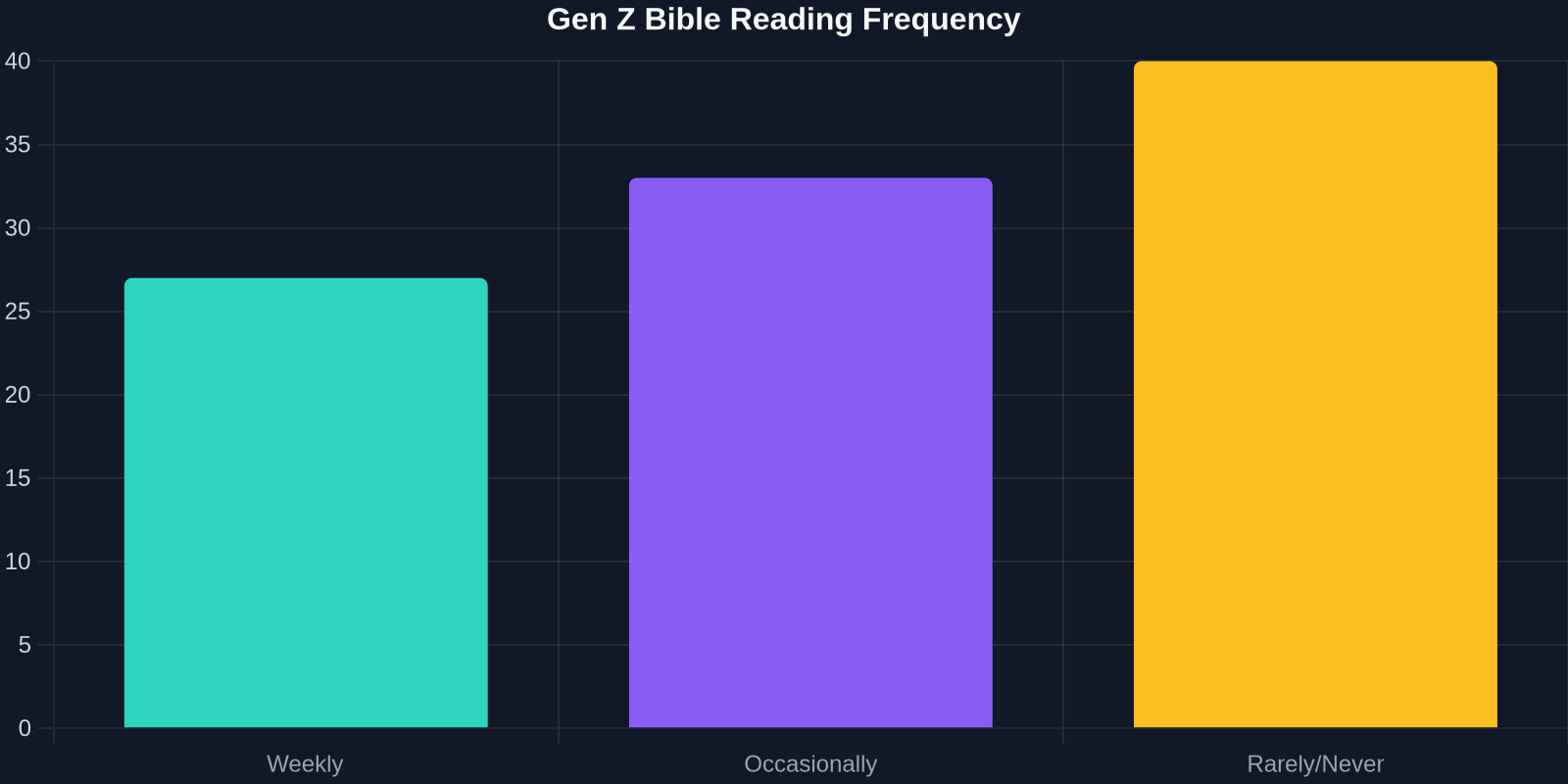
The chart above reflects a modest but real shift: a growing minority of Gen Z now reads the Bible at least once a week. Within that group, the KJV's share is rising, driven by curiosity about its literary quality and a desire for a more reverent encounter with Scripture.

Search data for the King James Version among 18- to 29-year-olds shows a steady climb over the past five years. This is not a fad that burns hot and fades; it is a gradual reclamation of a heritage many thought was lost.
A Closing Word for This Week
The King James Version does not need defenders or promoters. It has outlasted empires, revolutions, and every technological upheaval since the printing press. What it asks of you is simpler: open it. Let one verse stand before you, unhurried and unadorned. Let the old words do their old work of making you new.
This week, try this small habit: before you open any other app tomorrow morning, read one verse from the King James Version. Say it slowly. Then carry one phrase with you through the day. You may be surprised at how much weight those ancient syllables can bear.